Instructions for Be(com)ing

The first instruction is simple.
Forget that you are walking.
The map has already begun.

Long before our first step, someone decided where the road would run, where the forest would grow, where water should disappear and where a boundary would become permanent. We like to imagine landscape as something we enter. More often, landscape is something that has already entered us.
Pine forests stretch towards the horizon. Heathlands open into broad fields. Sand drifts across the dunes. Everything appears natural until the landscape begins to betray its own instructions. Trees stand in measured rows. Streams follow engineered gradients. Roads continue long after their original destination has vanished. The landscape behaves less like wilderness than like software: layers of decisions still running long after their authors have disappeared.
History does not vanish. It continues to execute.

For years we thought our work was about revealing those hidden codes. We walked, mapped, photographed and researched, convinced that every landscape contained another landscape beneath it.
Eventually we realized the map had changed direction.
It was no longer describing the land.
It was describing our presence.

Every route repeated another route. Every observation followed habits we mistook for intuition. Even our memory inherited ways of looking that felt personal only because they had become familiar. We had treated infrastructure as something outside ourselves, forgetting that humans may be its most durable material.
Perhaps we do not simply build systems.
Perhaps systems build us.
That changed everything.

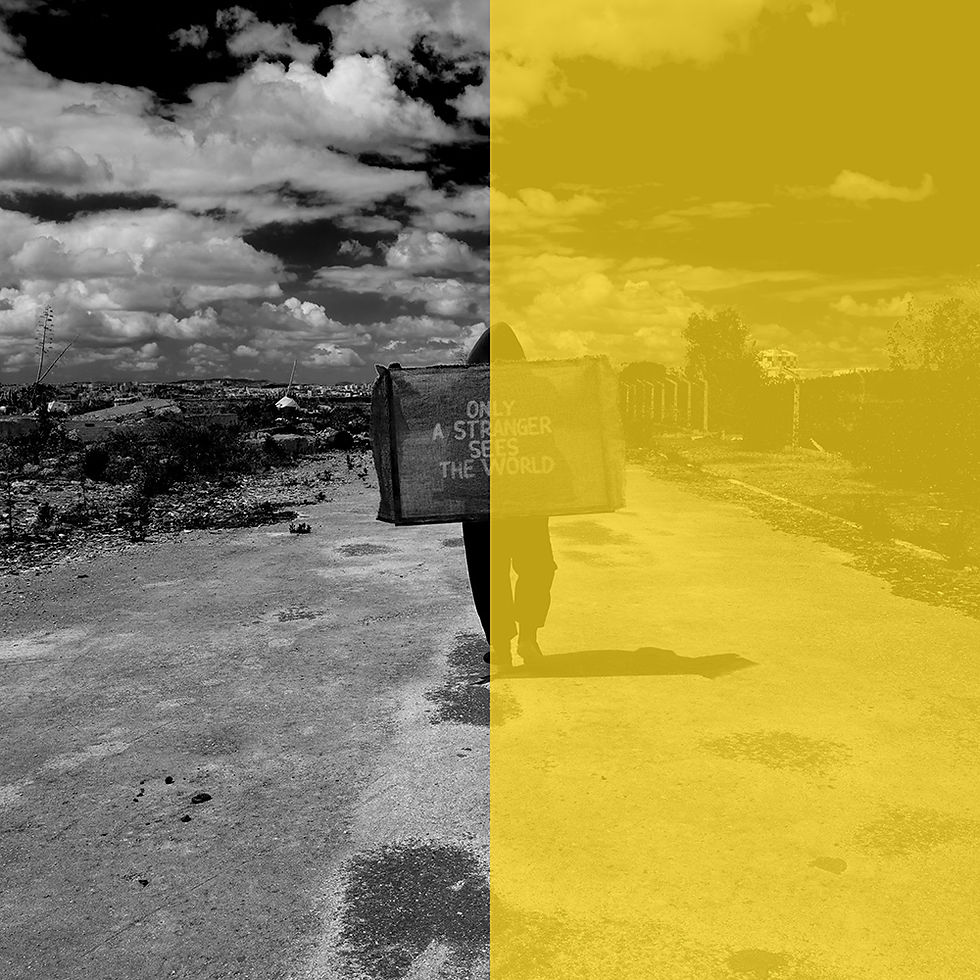
Our coloured interventions are often mistaken for overlays added to the landscape. They are closer to glitches. Temporary interruptions in the visual operating system through which a place normally becomes recognisable. They do not explain a landscape. They momentarily suspend the instructions through which certainty is produced.
For a brief moment the landscape refuses to compile.
In the end, our works become games.
Not because games are playful, but because every game begins with rules, and every rule reveals another one hiding beneath it. Walking itself is already governed by protocols: where we look, what we ignore, which stories become visible and which remain background noise.
A game simply makes those protocols available for rewriting.

Each player follows different instructions. One traces human activities. Another follows cultural identities. Someone notices urban revitalization. Someone else listens for community tactics, counts wealth structures or follows social constructions. The landscape itself barely changes. The instructions do.
Instead the landscape becomes multiple, assembled collectively through incompatible ways of reading the same ground.
Perhaps this has always been our work.
Not making new landscapes.
Not representing existing ones.
But writing temporary instructions that allow another world to become executable.
These are not instructions for walking.
They are instructions for be(com)ing.



Comments