Landscape 404

Brownfields have become postcards: sites where economic collapse is restaged as atmosphere. What once indexed failure now circulates as backdrop. Ruin is no longer evidence but surface, consumable, styled, detached from consequence.
PADA Studios, a former jute factory where we live and work between April and June, operates inside this condition. Since 2018 it has used access to the surrounding industrial estate as part of its programme. Its “industrial park tour” leads residents through restricted zones: old paint factories, emptied warehouses, decontaminated pyrite fields. What is structurally closed is reframed as experience. What is contaminated becomes itinerary.

From their website:“PADA has access to unique areas where the old brutalist remains of the CUF empire stand, such as the old paint factory or the north side with its vast empty warehouses, crumbling concrete structures and the now decontaminated pyrite fields. The post-industrial landscape offers a unique opportunity for artistic interventions.”
Access is not neutral here.
The language of “brutalist remains of the empire” echoes a broader condition described by Achille Mbembe: a planetary regime in which life is organised through extraction, logistics, and material control. Brutalism is no longer style but infrastructure, hardening the relation between matter, governance, and depletion.

We returned to jute as working surface. A fibre always already in transit, carrying goods and labour without stabilising into ownership. We treated it less as support than as witness: an archive that leaks rather than stores.
From CODE 04 and the conversation “The Cartographer” we carried fragments in which mapping is not description but operation, space rendered legible, extractable, administrable. That logic is not historical. It continues through tourism, circulation, and artistic access itself.

We stitched a sequence of Pessoan thoughts from the conversation into the jute:
— WHAT ONCE WAS, RUNS TO RUINS
— FOR THOSE WHO COME AFTER US
— TO NOWHERE IN PARTICULAR
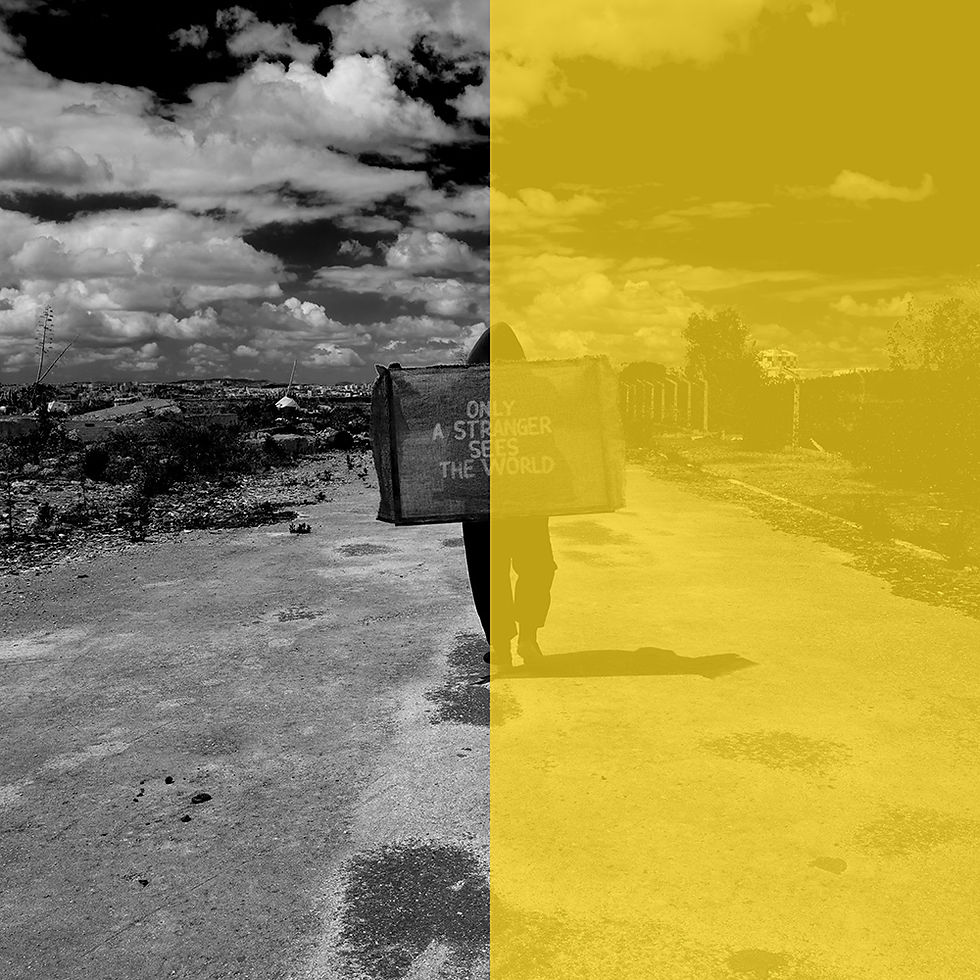
— ONLY A STRANGER SEES THE WORLD
Thread interrupts reading. Language thickens into surface. Meaning slows, partially obstructed. The work refuses transparency; it produces friction instead of message.
The initial proposal was to activate the stitched surface through projection: language thrown onto terrain by sunlight. In the studio this briefly held. In the landscape it failed. The projection did not arrive with enough force to register.

What emerged instead was the following figure.
A body carrying weight across the site, seen from behind. No face, no orientation toward the viewer. Not image-as-representation but image-as-condition: labour passing through a contaminated field where working ground and represented ground no longer separate.
“ONLY A STRANGER SEES THE WORLD” stops behaving like text. It breaks under readability. It does not clarify; it interferes. The stranger is not metaphor but temporary state, produced by movement through systems that exceed comprehension: labour, tourism, bureaucracy, artistic circulation.

Yellow appears as exhausted code: survey paint, hazard marking, logistical shorthand. A language that once organised space now persists as residue. It no longer signals; it stains.
In the field, signs do not operate. They drift. Control remains, but as style without function.
What remains is not landscape as site, but landscape as toxic reading surface: where documentation, intervention, fiction, and extraction occupy the same register, and meaning no longer detaches from material.



Comments