Yours, Within Ours

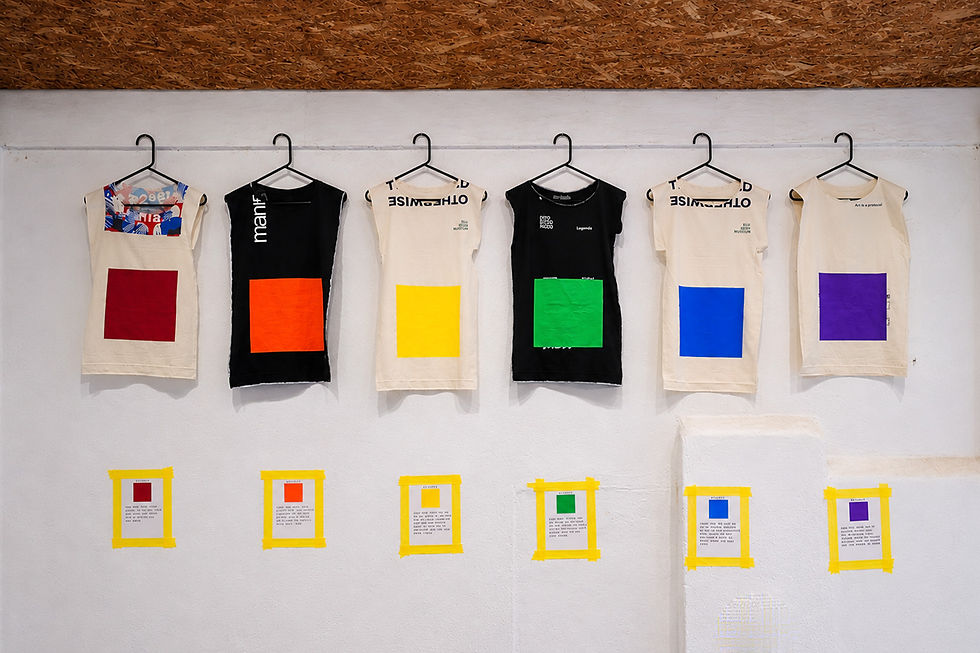
“Find a work at ALARM that appeals to you. Sit down in front of it and close your eyes. Try to keep seeing the work.”
One of six instructions we offered visitors during our working period at ALARM in Beugen. Each corresponded to a colour and an altered institutional tote bag that could be taken from its hanger and worn. We wanted to open our method to visitors: to let the exhibition become something they could act within and help produce.
The bags had accompanied us on journeys between European art institutions. We collected them from places we worked with or hoped to work with. They carried our belongings and advertised our destinations. Later, they became surfaces to paint on.
An institutional tote bag comes with a name, a logo and an affiliation. Carrying it distributes an institution’s image. Our work circulates through a related exchange: we contribute to institutional programmes; institutions help determine how we become visible. Painting on their merchandise allowed us to put their names to work within something of our own.
We began doing this after photographs documenting our performances appeared in a museum exhibition. The photographer was credited as their author. We were not named. Our actions remained visible, but their attribution had disappeared.
We began interviewing curators from institutions we worked with, selecting fragments of their speech and painting them onto the bags. First a coloured square, drawn from our coding system. Then the words.
At one presentation, a curator recognised his words.
“That’s my quote.”
He said it several times, surprised, then contemplative. We began talking. A sentence he recognised as his had become part of a work presented as ours.
At ALARM, these quotation works hung around the wearable bags. Both received the same treatment of painted colour; the wearable versions had openings cut into them and were paired with instructions instead of quotations. Words taken from earlier conversations surrounded invitations to act.

The instructions concerned the exhibition itself. Visitors contributed gestures, sounds and ways of attending to the works. We established the conditions; their interpretations would become part of an exhibition bearing our names.

Sometimes we explained this relationship before someone participated, sometimes afterwards. A visitor might respond playfully: “And now you’re stealing my interpretation.”
They had recognised the arrangement and found a way to tease us with it.
Others said nothing and returned to look at the quotations. Some described how the instructions had changed their experience: “I’ve looked at the exhibition completely differently.”
We had expected discomfort around the incorporation of someone else’s contribution into our work. Visitors also welcomed the opportunity to alter their relationship to the exhibition.
Ans Verdijk, who initiated and runs ALARM, drew visitors into the game, including when we were absent. The invitation continued through her, without our explanation to frame each encounter.
An artist finding their work uncredited and a visitor choosing to follow an instruction occupy different positions. We had approached participation through our experience of losing control over a contribution. Visitors could find something worth taking from the encounter themselves.
The instruction asks someone to close their eyes and keep seeing. We cannot inspect the image that persists, or know how it changes.
We can photograph the person sitting there.


Comments