The Anti-Screen

Updated: May 11
Lace entered our practice before a grand theory caught up.
We weren’t looking for symbolism, we watched light in slow motion.
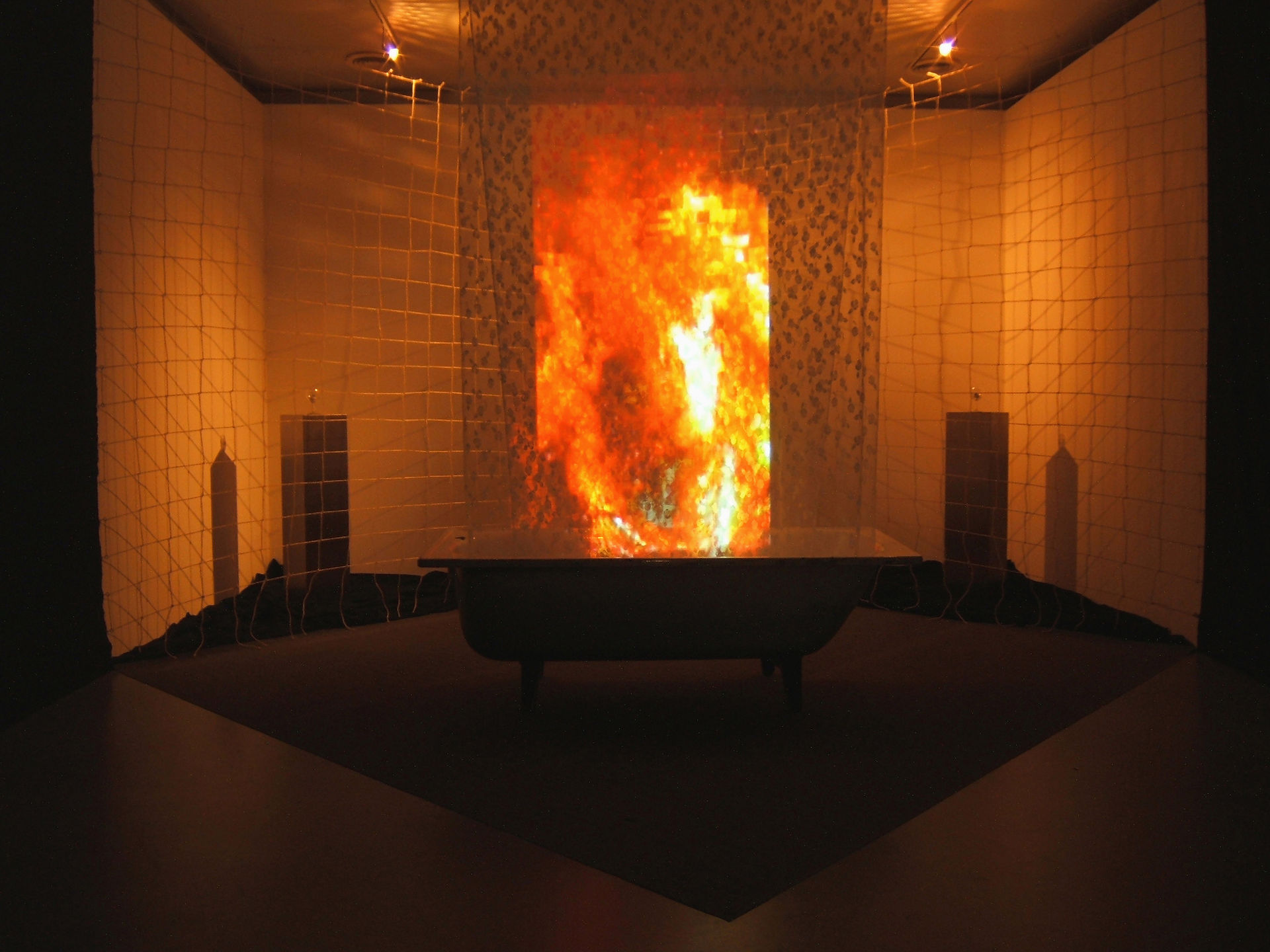
Angelic Space, 2005, installation view at Krabbedans, Eindhoven (NL)


In Angelic Space (2005), lace became an anti-screen: not a surface that receives an image, but one that distorts it. Projections pass through holes instead of landing cleanly. Color scatters. Shadows leaks. At first, nothing resolves. Then, slowly, perception clicks. The image doesn’t appear, it is assembled in the viewer’s mind. Slow-motion seeing changes everything. Lace slows vision down. It refuses instant clarity.
The eye has to wait, adjust, complete.
Seeing becomes work. The image is never fully given; it must be finished by a mental projection. In that moment, the viewer becomes complicit. The work exists only through their participation. Projection turns into a shared act of imagination.
Historically, lace always lived between worlds. Domestic and aristocratic, intimate and ceremonial, decorative and political. It dresses saints and lovers, altars and bedrooms, weddings and funerals. It carries labor, gender, class, and time, yet veils all that weight. Its eroticism is not explicit. It lies in suggestion, delay, incompleteness. Lace reveals without exposing, touches without enclosing. The projected image does not confront, it seduces. Desire is not in what is shown, but in the act of trying to see.
This is not the eroticism of spectacle.
It is the eroticism of deepened attention.
Using lace, a feminized, slow, manual material, as a mediator for digital projection creates friction. High-tech imagery becomes dependent on low-tech intelligence. Algorithms meet holes. Resolution meets loss.
Hotel Chelsea, 2015, offset print, ink, pencil, lace, vintage frame , 26,5 x 36,5 cm SCUM, 2015, inkjet on book page, offset print, ink, pencil, lace, vintage frame, 27,0 x 33,0 cm The Scarlet Lady, 2015, inkjet on book page, ink, pencil, lace, vintage frame, 23,0 x 31,0 cm.
Lace introduces noise into the clean logic of projection. It resists total visibility. In that resistance, it mirrors how we now experience reality: filtered, layered, incomplete, constantly reconstructed by the viewer.
Brain works harder.
More neurons fire.
Meaning emerges through effort, not consumption.
Our later research into the history of lace, linked to women’s labor before industrialisation, displaced knowledge, and migration, only deepened this thread. Lace refuses to settle. It adapts. It absorbs context. It moves effortlessly between the sacred, the erotic, the domestic, the political.

Lace is the anti-screen. Lace transforms surface into message.
In our practice, it functions less as material than as method: a way of thinking through light, space, history, and perception. A way of asking viewers to slow down, to complete the image, to take responsibility for what they see.
Lace doesn’t provide vision.
It opens space.


Comments