Greyzones Revisited: On absence, language, and minimal intervention

Updated: Feb 5
Greyzones begin with something that isn’t there.
The commissioned artistic investigation into Mike Kelley’s work for the Van Abbemuseum collection in 2017 began with a missing piece: Autographs, one of forty collages from Morgue, belonging to Kelley’s constellation Categorical Imperative and Morgue. Kelley writes about these works in Minor Histories (2004).
What first appeared as an archival malfunction refused resolution. There was no image, no shelf mark, no physical trace. Only language. Invoices, documents, descriptions, references leading elsewhere. Over the course of 385 emails exchanged with museums, estates, and archives, Autographs became a sequence, a work sustained through correspondence rather than material presence.

When it finally surfaced, it was not in storage and not autonomous. The collage had been absorbed into Extroversion (2012) by Franz West. In Vienna, conversations with West’s estates revealed how Kelley’s work could have migrated into another sculptural logic, not lost, but extended, re-situated, folded into a different system.
At that point, recovery no longer a priority.
Greyzones Revisited shifts attention from retrieval to circulation: to how artworks persist through language, how they disappear without vanishing, how institutions remember through archives as much as through collections.

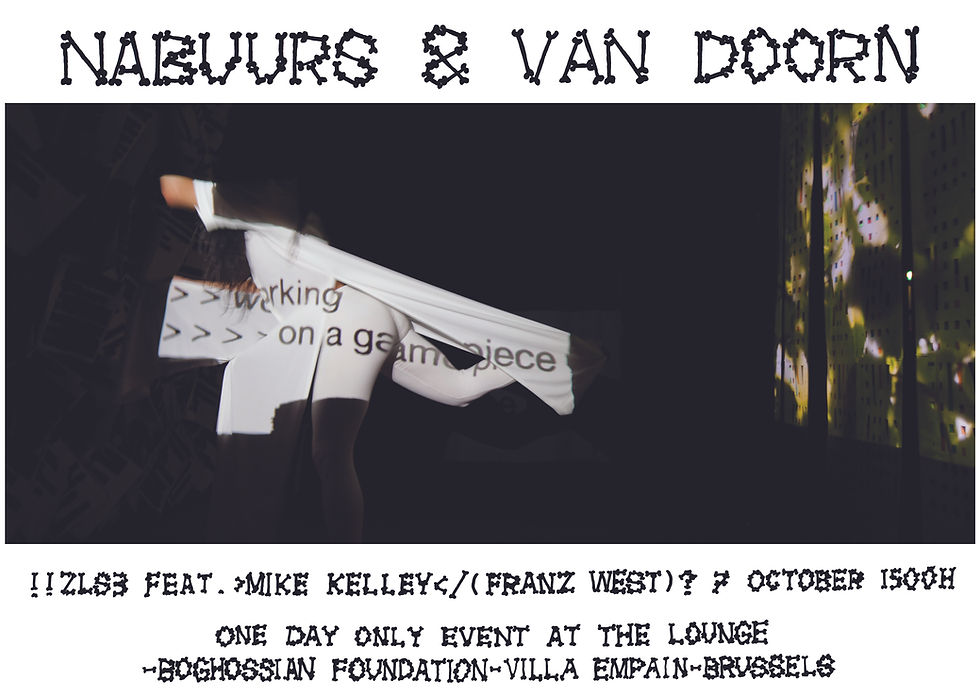
We began working with the emails themselves. Not their content, but their tone. Administrative phrasing. Procedural language. Polite deferrals. Fragments we digitally polarised and transformed into light-based text projections.
Early 2026, as visiting artists at 18th Street Arts Center, we again projected these fragments but instead of in public space we projected them in our L.A.-studio. Turning the studio itself into our canvas.
These projections introduce no object and leave no trace. They operate as minimal interventions: brief interruptions in perception, moments where language appears to be captured as image.

Greyzones Revisited is not a site-specific work, but a condition, one that remains open. It invites proximity: through attention, alignment, and responsibility for what briefly appears, and then disappears again.
The image becomes an echo without the sound that precedes it.
Comments